Free-lance curator/director based in Madrid, Spain, working either in public and private spaces since 1987
Günther Förg
- Curator: Alicia Chillida
- Coordination: Paz Fernández, Elena Fernández Manrique
- Design: Luis Enguita Arquitectura
- Place: Velázquez Palace, MNCARS, Madrid, 1998-1999
-
Itinerancy: IVAM Valencian Institute of Modern Art, Centre del Carme, Valencia, 1999
ARKEN Museum for Moderne Kunst, Copenhagen, 1999 - Photograph: Joaquín Cortés, courtesy of MNCARS
- See publication
Günther Förg. Alicia Chillida
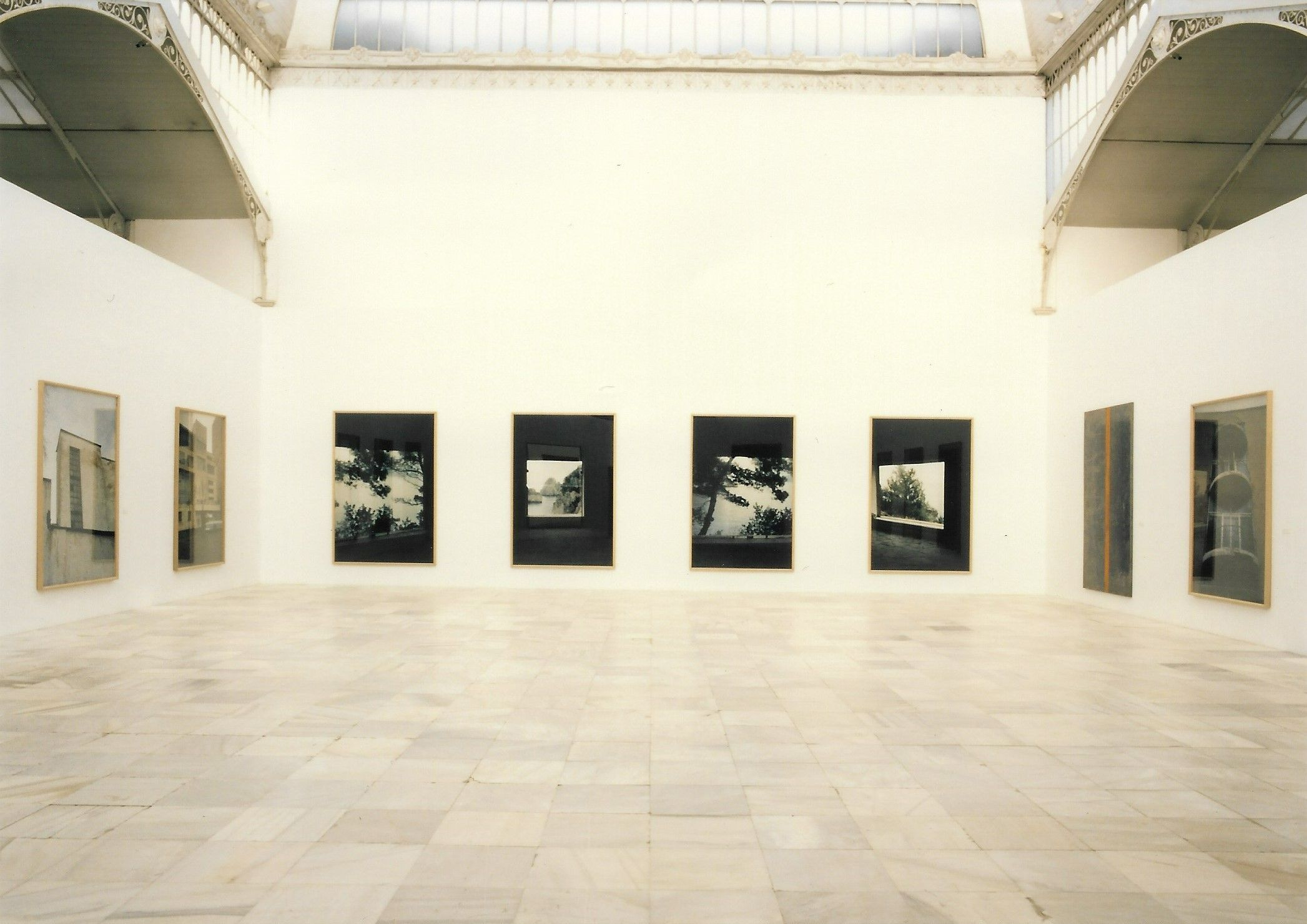
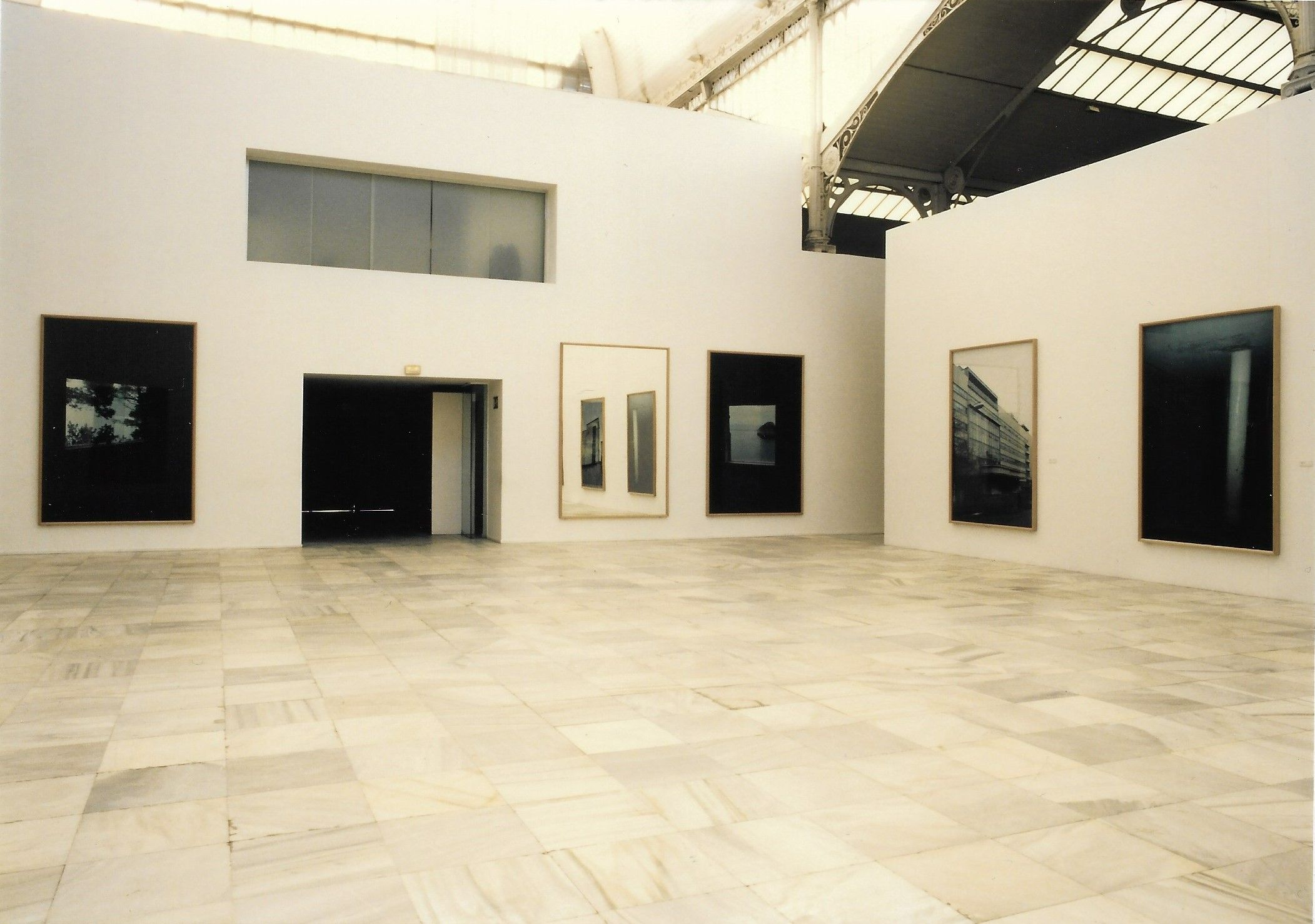
The strong spatial character of the Velázquez Palace becomes, once again, the starting point for a specific project. Günther Förg analyzes the place to reveal its qualities, enhance them and design a montage in which the work and its installation acquire an inseparable meaning.
Förg's work awakens ambivalent sensations; in addition to possessing the capacity to provoke the viewer's emotion, it also has a strong functional sense, creating contexts and generating meanings that refer to the objective aspect of reality. Thus, although the artist includes clear autobiographical components in his work, there is, at the same time, a will to distance himself from any moment of intimacy.
Förg frames his photographs in reflective glass, so that the image of the viewer reflected on the surface is automatically included in the composition and becomes another element of the narrative, which is thus devoid of any halo of privacy.
We notice references from artists as apparently disparate as Barnett Newman, Blinky Palermo or Jean-Luc Godard. From 1980 onwards, the author uses an unusual variety of techniques and supports in his work, producing simultaneous and equivalent assemblages, photographic works, mural paintings, watercolors, drawings, engravings, bronze structures and paintings, through which the artist deepens his research on the relationship between form, color and surface.
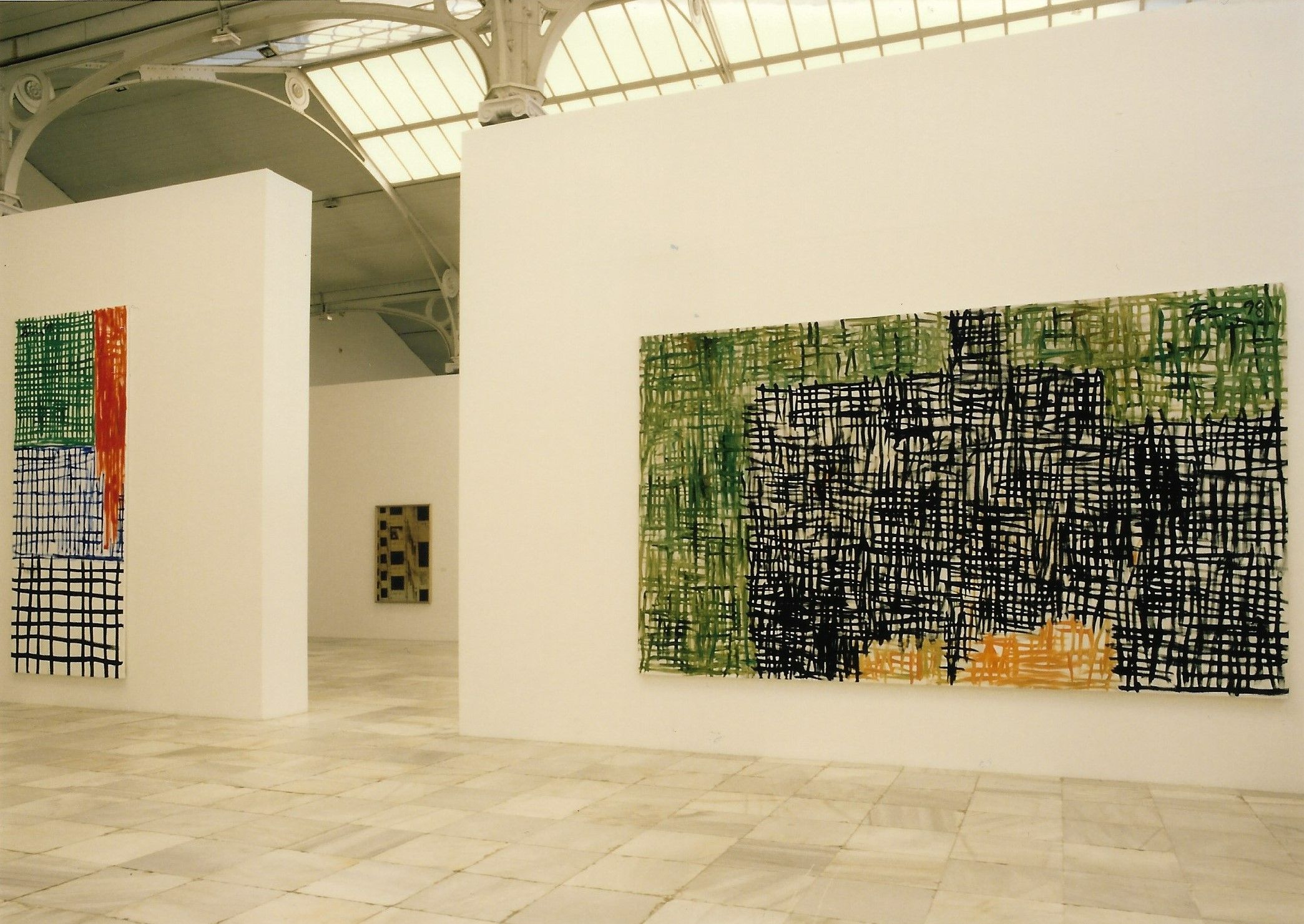
The exhibition at the Velázquez Palace revolves around large-format photography, on which the artist has been working since the 1980s. Architecture is the central theme of this photographic work, which is often combined with paintings and reliefs. Around this central structure are presented, in the adjacent rooms, works in other media: reliefs, sculptures, drawings and paintings.
His photographs show buildings emblematic of Bauhaus architecture, of the Soviet revolution in Moscow or of Italian and German rationalist architecture, confronted with female figures and portraits and even with references to the landscape. Although Förg is interested in an architecture with political content, it is not his intention to make a historical public judgment, but to pay homage to the rationality and clarity of the constructive structure. The uneasiness it provokes remains a cinematic suspense.
Förg belongs to a generation of artists for whom the debate about the legitimacy of abstract art is outdated. Abstraction is his natural language. In his paintings, whether on canvas, aluminum or lead, the physical surface of the painting is essential to experience the work.
At first glance, these paintings, because of their formal order in color and surface, are indebted to the constructivist tradition; however, the serene way in which the artist applies the paint on the support gives them a soft and volatile atmospheric quality, which is related to the romantic line of Germanic painting.
The author understands each new exhibition space and each new installation of his work as parts of his overall oeuvre. The work possesses an individuality in itself that makes us aware of our scale as viewers, while at the same time it speaks to us of the relationships and links that are established between the different works and the space that hosts them, and the role that the visitor interprets within the exhibition and the story.